Egg quality and assisted reproduction
Interest in myo-inositol extends beyond natural conception to assisted reproductive technologies (ART), including in vitro fertilization (IVF).
Several systematic reviews suggest that myo-inositol may improve oocyte maturation, embryo quality, fertilization rates, and clinical pregnancy rates among women with PCOS undergoing ART.[6-9] Some studies also report favorable effects on ovarian stimulation parameters, including reductions in anti-Müllerian hormone levels and antral follicle counts.[8]
Nevertheless, these findings should be interpreted cautiously. Most available studies are heterogeneous, involve relatively small sample sizes, and rarely report live birth outcomes. A recent review even questioned whether enthusiasm for myo-inositol has outpaced the quality of supporting evidence.[10]
Metabolic and hormonal effects
Because insulin resistance is central to PCOS, many studies have examined whether myo-inositol improves glucose metabolism, insulin sensitivity, androgen levels, and lipid profiles.
Current evidence suggests modest improvements in several metabolic markers and reductions in hyperandrogenism, changes that may indirectly support ovulation.[1,3]
Comparisons with metformin, an established insulin-sensitizing medication, show mixed results. A systematic review found no clear differences between myo-inositol and metformin in hormonal or ovarian outcomes, although myo-inositol was associated with fewer gastrointestinal adverse effects.[11] Current guidelines also suggest that metformin may provide greater benefits for certain metabolic outcomes and hirsutism, whereas the overall effectiveness of inositol remains uncertain.[1]
Safety
Myo-inositol appears to have a favorable safety profile. Most clinical trials report only mild, self-limiting adverse effects, with gastrointestinal symptoms occurring less frequently than with metformin.[1,11] Its good tolerability is one reason many individuals choose to try it, often before seeking specialist care.
What this means in practice
The available evidence does not support two common extremes: that myo-inositol “cures” PCOS or that it has no value.
Instead, current research suggests that myo-inositol may benefit some women, particularly those with insulin resistance, by improving menstrual regularity, supporting ovulation, and modestly improving metabolic health.[1,3] However, evidence remains limited regarding pregnancy, live birth, and long-term cardiometabolic outcomes.
PCOS is a highly heterogeneous condition. Responses to treatment vary according to phenotype, metabolic status, and reproductive goals, meaning that no single intervention is effective for everyone.[13]
Rather than viewing myo-inositol as a stand-alone solution, it is more helpful to think of it as one component of a comprehensive management plan that may also include nutrition, regular physical activity, adequate sleep, stress management, and evidence-based medical therapy when indicated.
Common myths about myo-inositol
Myth 1: “Myo-inositol guarantees pregnancy.
It does not.
Studies show that myo-inositol may improve ovulation and, in some settings, increase clinical pregnancy rates.[4,5,8] However, current evidence remains insufficient to conclude that it improves live birth rates.[1] Individual responses vary considerably.
Myth 2: “Everyone with PCOS should take myo-inositol.”
Not necessarily.
The International Evidence-Based PCOS Guidelines describe inositol as an optional treatment with uncertain overall effectiveness rather than a universal recommendation.[1] Decisions should reflect individual symptoms, fertility goals, and personal preferences.
Myth 3: “Myo-inositol replaces lifestyle changes.”
Lifestyle modification remains the cornerstone of PCOS management.
Healthy eating patterns, regular exercise, weight management when appropriate, and adequate sleep improve insulin sensitivity and reproductive health, whether or not supplements are used.[13] Myo-inositol should be considered an adjunct, not a substitute, for these foundational measures.
Myth 4: “Higher doses work better.”
More is not necessarily better.
Clinical trials generally evaluate standardized doses over defined treatment periods. There is little evidence that higher doses or combining multiple supplements provides additional benefit, while doing so may increase costs without improving outcomes.[1]
Lifestyle still matters most
Even when supplements are discussed, lifestyle remains the foundation of PCOS management because it influences many of the same biological pathways targeted by myo-inositol.
Nutrition
A dietary pattern rich in vegetables, fruits, legumes, whole grains, lean proteins, and healthy fats can improve insulin sensitivity and reduce excessive insulin secretion. There is no single “PCOS diet,” but consistent eating habits that support stable blood glucose levels may improve hormonal regulation.
For women considering myo-inositol, supplementation is most likely to complement, not replace, a healthy dietary pattern.
Physical activity
Regular exercise improves insulin sensitivity independently of weight loss and has been associated with better menstrual regularity and ovulatory function.[13] Walking, resistance training, and aerobic exercise can all contribute to improved metabolic health.
Combining physical activity with myo-inositol addresses both insulin signaling and the body’s response to insulin, potentially enhancing overall treatment effectiveness.
Sleep and stress
Poor sleep quality and chronic stress may worsen insulin resistance and hormonal imbalance. Maintaining consistent sleep schedules and incorporating practical stress-management strategies may help optimize reproductive health alongside other treatments.
When should you seek professional advice?
Although myo-inositol is generally well tolerated, self-directed supplementation has limits. Consulting a healthcare professional is especially important if:
-
- You have been trying to conceive for 6–12 months (or sooner if you rarely ovulate) and are considering supplements instead of evidence-based fertility treatment.[1,4]
-
- You are taking medications that affect blood glucose, thyroid function, blood pressure, or mental health and want to avoid potential interactions.
-
- You have a less typical PCOS presentation, such as lean PCOS or marked hyperandrogenism, where treatment responses may differ.[12]
-
- You are preparing for or undergoing in vitro fertilization (IVF) or another assisted reproductive technology (ART) cycle and want individualized advice about myo-inositol.[6-10]
Shared decision-making is particularly valuable because current international guidelines conclude that evidence supporting inositol remains promising but inconclusive across many clinically important outcomes.[1]
Future directions in research
Research on myo-inositol has evolved from early, encouraging clinical trials to more rigorous systematic reviews. While interest remains high, several important questions are still unanswered.[1]
Future studies should determine:
-
- Which PCOS phenotypes benefit most from myo-inositol supplementation.
-
- Whether specific MI ratios are superior for different reproductive goals.
-
- How myo-inositol compares directly with established ovulation-induction therapies in large trials measuring live birth and long-term metabolic outcomes.
-
- How supplementation can be integrated with lifestyle interventions and mental health support to improve quality of life as well as fertility.[1,10]
As evidence continues to evolve, treatment decisions should balance potential benefits with scientific uncertainty rather than relying on marketing claims or anecdotal success stories.
What this means for families and communities
PCOS affects more than fertility alone. It can influence emotional well-being, healthcare costs, family planning, and long-term metabolic health.
Understanding myo-inositol within this broader context encourages more realistic conversations. Instead of expecting a supplement to “fix” PCOS, individuals and families can focus on comprehensive care that includes healthy lifestyle habits, appropriate medical treatment, emotional support, and regular follow-up.
Online communities and support groups also play an important role. Sharing personal experiences can be encouraging, but individual stories should be interpreted alongside high-quality scientific evidence. A treatment that works well for one person may not produce the same results for another.
Key takeaways
Current evidence suggests that myo-inositol may support ovulation, improve menstrual regularity, and modestly improve metabolic health in some women with PCOS, particularly those with insulin resistance.[1,3,5] However, evidence for improving pregnancy and live birth remains limited, and responses vary among individuals.
If you are considering myo-inositol, ask yourself:
-
- Does it complement, not replace, healthy eating, regular physical activity, adequate sleep, and stress management?
-
- What specific outcomes are you hoping to achieve, and how will you measure whether it is helping?
-
- When will you review your progress with a healthcare professional rather than continuing supplementation indefinitely?
Approaching myo-inositol with realistic expectations promotes informed decision-making and emphasizes that successful PCOS management is usually achieved through a combination of lifestyle measures, individualized medical care, and, when appropriate, selected supplements.
Frequently Asked Questions
How does myo-inositol help ovulation in PCOS?
Myo-inositol acts as an intracellular messenger involved in insulin and reproductive hormone signaling. Because these pathways are often disrupted in PCOS, supplementation may improve insulin sensitivity, increase ovulation rates, and promote more regular menstrual cycles. However, responses vary, and evidence for improving live birth remains limited.[1,3-5]
Can myo-inositol improve egg quality during IVF?
Several studies involving women with PCOS undergoing IVF or other ART procedures suggest that myo-inositol may improve oocyte maturity, embryo quality, and clinical pregnancy rates.[6-9] However, evidence for improving live birth is inconsistent, and larger randomized trials are still needed.[1,10]
Is myo-inositol safer than metformin?
Both treatments are generally considered safe when used appropriately. Compared with metformin, myo-inositol is associated with fewer gastrointestinal side effects, although current evidence does not show clear superiority for hormonal or ovarian outcomes.[1,11] The most appropriate treatment depends on an individual’s symptoms, metabolic profile, and reproductive goals.
Should everyone with PCOS take myo-inositol?
No. Current international guidelines consider myo-inositol an optional treatment because evidence remains uncertain.[1] Lifestyle interventions continue to be the foundation of PCOS management, and treatment decisions should be individualized.
How long should I try myo-inositol?
Most clinical studies evaluate myo-inositol over approximately three to six months.[1,5] During this period, it is helpful to monitor menstrual cycles, ovulation, symptoms, and metabolic markers with your healthcare professional to determine whether continued supplementation is worthwhile.
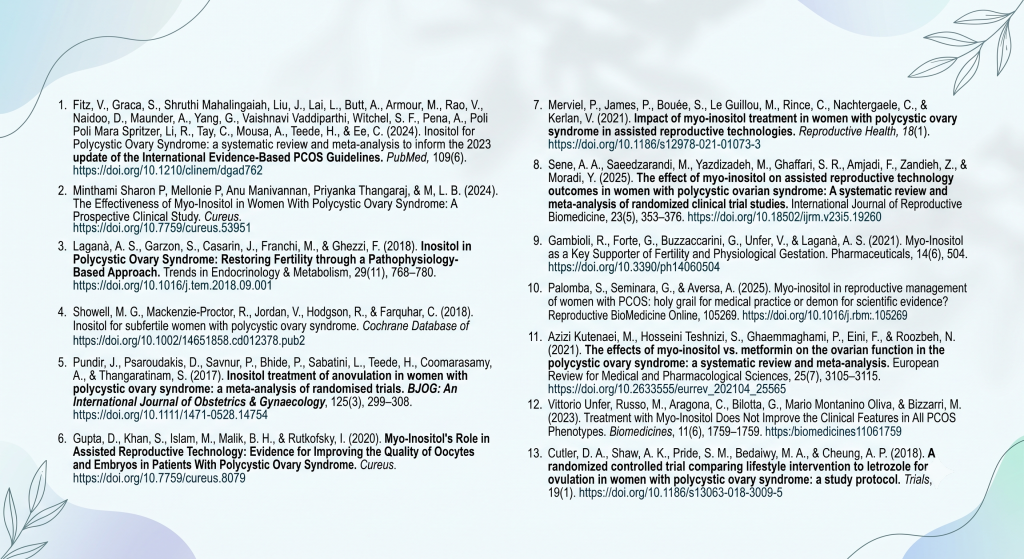
References:
About the Author
Jaclyn P. Leyson-Azuela, RMT, MD, MPH
Dr. Leyson-Azuela is a physician, public health professional, and medical writer specializing in healthcare innovation, pharmaceuticals, medical technology, health policy, and evidence-based medicine. With expertise spanning clinical practice, public health, and scientific communication, she translates complex healthcare developments into strategic insights for healthcare leaders, industry stakeholders, and decision-makers.
About Phaidros Healthcare
Phaidros Healthcare is a science-driven healthcare company committed to advancing evidence-based innovation across pharmaceuticals, nutraceuticals, and medical technologies. Guided by rigorous research and a commitment to clinical excellence, we collaborate with healthcare professionals, researchers, and industry partners to translate emerging scientific discoveries into practical solutions that improve patient outcomes. Our focus extends beyond product development to fostering informed discussions on formulation science, bioavailability, regulatory trends, and healthcare innovation. By bridging cutting-edge pharmaceutical expertise with evolving nutraceutical technologies, Phaidros Healthcare supports the development of high-quality, clinically credible solutions that meet the growing demands of modern healthcare. Through thought leadership, strategic partnerships, and a steadfast commitment to scientific integrity, we strive to empower clinicians, industry stakeholders, and consumers with knowledge and innovations that drive better health and lasting value.